

Why Small Apartments Need Zones More Than Storage
Most people try to solve small apartments the same way: they buy storage. Boxes, shelves, baskets, hidden organisers.
And for a moment, it works. The space looks calmer, surfaces clear, things disappear. But a few days later, the same problem returns. Not because there isn’t enough storage. But because storage is solving the wrong problem.
Small apartments are not storage problems. They are overlap problems.
In small homes, almost nothing has a single function. A dining table becomes a desk. A bed becomes a sofa. A corner becomes workspace, storage, and waiting area depending on the hour.
The issue is not multi-functionality.
It is simultaneity. Multiple versions of life happening in the same place at the same time. And that is what creates friction.
Not clutter.
Overlap.
When this shows up in real spaces
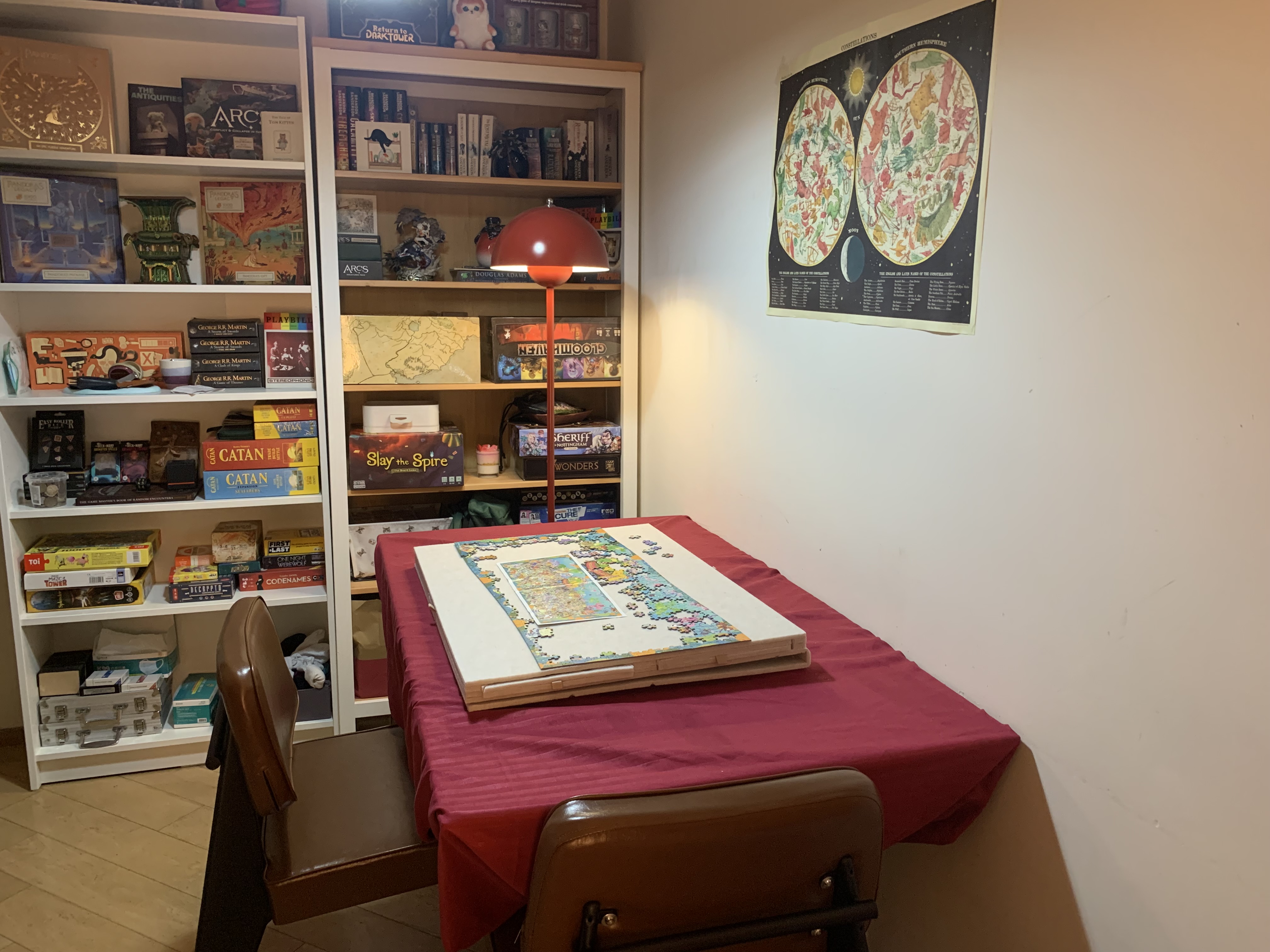
In one small rental, I worked with a dining table that kept becoming the centre of everything.
It wasn’t messy in the traditional sense. It was overloaded with roles. Work, play, social use, hobbies all competing for the same surface without structure.
The turning point came from mapping how often each function actually happened:
- board games: 1–2x per week
- work: 3x per week
- poker: 1x per month
- puzzle: 1x every 2 months
- dining: a few times per year
And yet, the space was being organised as if all of these uses were equal. Including the unwanted one: constant clutter accumulation.
The real question wasn’t how to store things better. It was what the table needed to be when nothing was happening.
It is not storage. It is overlap.
The missing layer: a rest state
What most small apartments lack is not storage or organisation. It is a clear resting condition. A surface that returns to neutral so the next action can begin without negotiation. Without that, every new use inherits the last one.
So even simple things become heavier than they should be.
You are not just setting up a puzzle. You are clearing work. You are not just having dinner. You are reorganising yesterday.
Over time, the space stops feeling like something you live in. It becomes something you constantly manage.
The priority wasn’t storage. It was continuity.
That shift changed everything. Instead of trying to “fit” each activity more neatly into the space, the focus became:
How does each activity appear and disappear without disrupting the next one?
That’s when the puzzle stopped being part of the table permanently.
Not because it wasn’t useful. But because it interrupted the system.
Storage was the wrong solution
The instinct is always to contain things better. To hide them, stack them, organise them.
But storage doesn’t solve overlap. It only delays it.
So instead of forcing everything into boxes, the system changed. A simple foam puzzle board was introduced. It lives under the sofa. It comes out when needed. Then disappears completely without affecting anything else.
Nothing about the space became more “minimal.” But something became more stable. Each activity now has a way in, and a way out.
This is what zoning actually means
Zones are not about dividing space. They are about separating behaviours. Not physically. Structurally.
A zone tells your mind: this is how this space behaves.
Not permanently. But predictably enough that you stop rethinking it every time.
Storage hides objects. Zones shape behavior.
Storage answers: where does this go?
Zones answer: what is this space doing?
Without zones, storage becomes a way of postponing decisions.
With zones, storage becomes support for transitions.
Why small apartments feel chaotic even when they are not cluttered
You can remove half your belongings and still feel like your space isn’t working. Because the problem was never volume. It was overlap. Multiple roles competing for the same surfaces without structure or sequence.
That creates a specific kind of fatigue. Not visual overload. But behavioural friction.
What changes when zones exist
When zones are even loosely defined:
- you stop re-deciding what each surface is for
- you stop clearing things just to immediately reuse the space again
- activities become easier to start and easier to end
- your home stops feeling permanently mid-transition
And instead of managing your space, you start using it.
Storage still matters, but only after zones exist
Storage is not the enemy. It is just not the foundation. Once zones are clear, storage has a purpose: to support resets between uses. Not to absorb confusion.
Without zones, storage becomes hiding. With zones, storage becomes structure.
This is the shift most rental apartments are missing
People try to improve their homes by:
- making them cleaner
- making them more minimal
- adding more storage
- buying better furniture
But the real shift is simpler than all of that. Not less life. Not more storage. Just clearer separation between how life actually moves through space.
If this resonates
This is the kind of work I do at After Dark Studio.
I help renters shape spaces around how they actually live, using what they already have, without renovation or unnecessary spending.
Most people think their space needs fixing. Often it just needs structure.
Book a free 15-minute Home Fit Call
Not ready for that?
Join the mailing list for occasional essays on rental living, small-space design, and the relationship between homes and everyday life.
No spam. Just occasional notes on how people actually live in small spaces.
You might also like: Why your bedroom doesn’t feel restful (even when it looks fine).